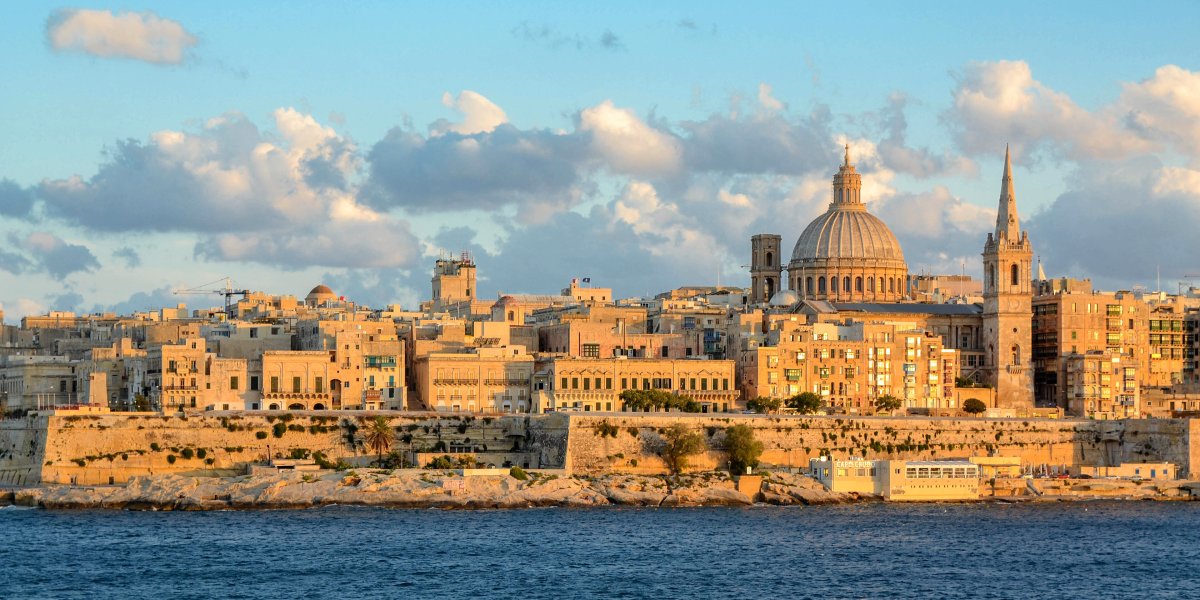
City Guide
Valletta
Malta · Best time to visit: Apr-Jun, Sep-Nov.
Day-by-day plan
Choose your pace
Reisedauer
09:00
Landmark
Arrive at the bus terminus and step straight onto the open plaza where three bronze tritons hold up a basin against a backdrop of 16th-century ramparts. Behind them rises Renzo Piano's limestone City Gate, a razor-sharp cut through the bastion walls that leads you into the capital. The collision of 1959 bronze and 21st-century minimalism against Baroque stone is Valletta's first honest sentence: this city has never stopped being built.
Tip: Stand 15 metres back from the fountain with the City Gate framed dead-centre behind the tritons — the low east-facing sun at 09:00 sidelights the bronze so the muscles read as alive, an angle the noon tour buses will never see. Walk through the gate on foot; skip the horse-carriage touts at the fountain's edge who quote €40 for the same 300 metres.
Open in Google Maps →09:45
Park
Turn left immediately after City Gate and follow Castille Place uphill for three minutes, passing the amber façade of the Auberge de Castille (now the Prime Minister's office) catching the morning sun. The gardens open at the highest point of the city wall onto a colonnaded terrace staring straight down at the Grand Harbour and the Three Cities across the water — the single most photographed view in Malta. Come now, not at noon: the light is cleaner off the water, the stone glows honey-gold, and the balustrade is empty before the 12:00 saluting-battery crowd arrives.
Tip: Walk to the far-right end of the terrace and shoot through the last stone arch — it frames Senglea's Gardjola watchtower directly over open water, the shot every Malta guidebook steals. Skip the noon cannon firing entirely: you watch from the upper terrace while the garden packs shoulder-to-shoulder, and the payoff is a single loud bang. The real experience is the quiet harbour at 10:00 with a coffee from the kiosk at the entrance.
Open in Google Maps →10:45
Religious
Descend the Castille steps, walk four minutes north on South Street, then turn right onto Republic Street — the cathedral's startlingly plain façade appears one block on your left. The Knights of St. John deliberately left the outside austere so the gold-drenched interior would hit you like a hammer; you are choosing exteriors today, but the honey limestone of the side wall glows against the deep cobalt Valletta sky in a way no interior photo can match. Sit in the café on St. John's Square opposite and watch pilgrims file in beneath the bronze doors.
Tip: The photogenic face is the side entrance on St. John's Square (north flank), not the front on Republic Street — aim for the stone staircase and bronze doors around 11:15 when the sun crosses the façade diagonally. You are skipping Caravaggio's Beheading of Saint John inside; be honest with yourself that this is the one regret of the day, and accept it — the interior queue in season is genuinely 90 minutes and would eat your Fort St. Elmo walk.
Open in Google Maps →12:00
Food
Walk three minutes east on Merchants Street — the restored 19th-century covered market with its iron-and-glass roof is unmistakable on your right. This is Malta's best street-food hall: grab pastizzi tal-irkotta (flaky ricotta pastries, €0.60 each — order three) from the Maltese counter to your left, then a ftira biz-zejt (Maltese sourdough with tuna, olives, capers, and sun-dried tomato, around €7) at the bakery stall. A cold Cisk lager at €3 finishes it.
Tip: Eat at the counters on the ground floor; the upstairs sit-down restaurants carry a 50% tourist markup for the same food. Ask the pastizzi counter which tray just came out — they re-bake every 30 minutes and a ricotta pastizz three minutes out of the oven (flakes shattering, molten inside) is one of the simplest perfect things you will eat in Europe.
Open in Google Maps →13:15
Landmark
Exit the market north, cross one block east to Strait Street — the narrow alley that was the British Navy's jazz-age red-light district, now lined with sleepy bars — and follow it flat for 15 minutes to the peninsula's tip. Walk the outer fortifications clockwise: the Siege Bell War Memorial tolls every day at noon for the WWII convoy dead, the neoclassical temple of Lower Barrakka Gardens sits directly below it with a second harbour view, and Fort St. Elmo's bastions at the very point face the open Mediterranean where the 1565 Great Siege began. No tickets, no queues — three hours of walls, sea wind, and honey stone.
Tip: The unknown photo of Fort St. Elmo is from sea level: past the fort's main gate, follow the stone ramp right-hand down toward St. Elmo Bridge — zero tour groups, the bastions tower straight up from the water. Pitfall warning: the seafront restaurants along the Fort St. Elmo promenade post €28 pasta menus aimed at cruise passengers — do not eat here. The horse-carriage drivers at the Fort gate are a scam quoting €50 for the same 10-minute walk you just did; ignore them firmly.
Open in Google Maps →19:30
Food
Walk back south on Strait Street for eight minutes; Legligin is a candle-lit basement door at number 119 with no sign — just ring the bell. An ex-sailor cooks a nightly set menu of six small Maltese plates from whatever was at market that morning: fenek stuffat (rabbit stew, the national dish), bragioli (beef olives in red wine), grilled octopus with capers, and a bean dip called bigilla to start. €35 per person for the six-course menu, house Maltese red at €18 a bottle.
Tip: Reserve by phone before noon the same day — they do not take online bookings and walk-ins get turned away by 20:00. Ask specifically for a table in the back stone-vaulted room, not the front bar. Come hungry: if the owner likes your enthusiasm he brings out extra plates he does not charge for, and the house wine keeps appearing on the table.
Open in Google Maps →Zu Tag springen
09:30
Religious
Start on St. John Street, five minutes from the City Gate — arrive right as the doors open at 09:30, when the gold-encrusted nave is silent and Caravaggio's Oratory has no queue. The Beheading of Saint John the Baptist — his only signed work — hangs in a side chamber; the audio guide is included and genuinely essential here. Give it the full two hours.
Tip: Skip the first ticket kiosk and head straight to the Caravaggio Oratory on the right — by 10:30 a tour-bus line wraps the chamber. Photography is banned in the Oratory, so just stand there: this is a painting you've seen in art books your whole life, give it ten silent minutes.
Open in Google Maps →11:45
Museum
Turn right out of the Cathedral and walk three minutes north on Republic Street to Palace Square — you'll pass the British-era Main Guard arch along the way. The State Rooms drip with Gobelin tapestries and Great Siege frescoes; the Armoury downstairs holds the actual suits of armour worn by the Knights of Malta. Get the combined ticket at entry — singles cost nearly the same.
Tip: The Ambassadors' Chamber is the single most striking room in Malta — its painted frieze tells the entire 1565 Great Siege in one wall. Slow down there; everything else is supporting cast. Parliament occasionally closes the State Rooms for half-days, usually Wednesday afternoons — check the board at the door.
Open in Google Maps →13:15
Food
Cut one block west onto St. Dominic Street — the bakery occupies a restored 16th-century townhouse with its original wood-fired stone oven still running in the open kitchen. Order the ftira biz-zejt (stone-baked flatbread with tomato, olives, tuna, capers, €14) and the rabbit-stuffed ftira (€16); both are generous, skip starters. A glass of local Gellewża red pairs naturally (€5).
Tip: Ask to sit in the glass-roofed inner courtyard — it's 4-5°C cooler than the front room at lunch. They don't take bookings before 13:00, so either arrive at 13:15 on the dot or after 14:00 to dodge the office-lunch rush in between.
Open in Google Maps →15:00
Museum
Walk five minutes east along Republic Street to number 74 — a discreet green door beside an unmarked baroque façade you'd otherwise walk past. This is the private home of the de Piro noble family, lived in continuously for 400 years and shown only via hourly in-person tours. The subterranean WWII shelter dug into the bedrock is the highlight — an entire hidden world beneath the drawing room.
Tip: The 15:00 tour is often led by the Marquis himself — most reliably on Thursdays and Fridays — and it's the most intimate aristocratic house tour you'll take in Europe. The tour runs exactly 45 minutes; arrive even two minutes late and you lose it entirely, no make-up.
Open in Google Maps →15:50
Park
Head back down Republic Street, then cut southwest through Old Bakery Street — ten minutes of gentle downhill to Castille Place. Arrive by 15:55: at 16:00 sharp a red-coated gunner fires the Saluting Battery cannon over the Grand Harbour below, a tradition unbroken since the Knights. Stay for golden hour, when Fort St. Angelo glows pink across the water around 17:30 and the harbour silvers over.
Tip: Don't waste time queuing for the Barrakka Lift down to the Waterfront — twenty minutes gone for nothing, the view from up top is better. The best harbour photo is framed through the middle arch of the colonnade, not over the front railing; the arch cradles Fort St. Angelo perfectly.
Open in Google Maps →19:30
Food
Walk five minutes back up Republic Street to number 211 — a vaulted 18th-century cellar behind an unassuming façade, now a one-Michelin-star modern Maltese kitchen run by chef Jonathan Brincat. Go for the five-course tasting menu (€80) — the rabbit ravioli and the Maltese honey dessert are why locals book weeks ahead. The wine pairing (€45) leans on tiny Gozitan vineyards you won't find exported anywhere.
Tip: Reserve at least two weeks ahead — this is the one Valletta table that truly sells out. Valletta tourist-trap warning: do not eat at the terrace restaurants on Republic Square with harbour-view placards and English-only menus; they charge €25 for frozen seafood pasta no local would touch. Simple rule — if the menu has photos of the food, walk past.
Open in Google Maps →09:00
Museum
From the City Gate, walk the full length of Republic Street — fifteen minutes through the still-sleepy old town down to the peninsula's tip. Open at 09:00, the star-shaped fortress gives you its ramparts alone before cruise-ship groups arrive around 10:30. The National War Museum inside covers the 1565 Great Siege and Malta's George Cross WWII story in equal weight — don't rush the WWII section, this island was the most-bombed place on earth in 1942.
Tip: Head straight to the top rampart first for the 360° view over Grand Harbour and Marsamxett — after 11:00 you'll queue for the staircase. On Sundays at 11:00 the free In Guardia re-enactment fills the parade ground with knights in period armour — check the fort website the night before to confirm.
Open in Google Maps →11:15
Park
Leave Fort St. Elmo through the southern gate and follow the harbour-side promenade for five minutes — the Grand Harbour stays on your left the entire way, with Vittoriosa visible across the water. The neoclassical Doric temple inside the gardens honours Sir Alexander Ball, who took Malta for Britain in 1800. Just beyond, the 10-ton Siege Bell tolls every day at noon for the 7,000 Allied dead of Malta's wartime convoys.
Tip: Time your arrival for exactly 12:00 — the Siege Bell's toll hits you physically, you feel it in your chest before you hear it. The small balcony just below the bell is the best photo spot in Valletta for the Three Cities skyline across the harbour, and almost nobody knows about it.
Open in Google Maps →12:45
Food
Walk west eight minutes up Old Mint Street, then left onto Merchants Street — the restored Victorian iron-and-glass market hall is on your right. Order pastizzi (ricotta and pea, €0.80 each), a rabbit-stuffed ftira (€5), and a glass of Gellewża rosé from the wine bar. This is how Maltese actually eat lunch — counter-side, fast, honest, five euros all in.
Tip: Skip the basement sit-down restaurants with printed menus — order at the ground-floor counters and point at what locals are eating. Two pastizzi plus a ftira feeds you for under €5 and tastes better than every sit-down pasta place on Republic Street combined.
Open in Google Maps →14:00
Entertainment
Walk three minutes north on Old Theatre Street to number 115 — the quiet façade hints at nothing. Built in 1731, the Manoel is Europe's third-oldest working theatre: a perfect miniature of gilded wood boxes stacked three tiers high around a teardrop-shaped auditorium. The guided tour puts you onstage and into the royal box — catch the 14:00 slot, the emptiest of the day.
Tip: Ask the guide to show you the hand-painted ceiling rotating dome — it opens for summer outdoor performances, and almost no tour groups ever notice the mechanism. Buy the €5 program booklet for the theatre's full history if you want a keepsake — the €15 coffee-table book in the gift shop isn't worth the markup.
Open in Google Maps →15:15
Museum
Exit onto Old Theatre Street, turn right, and walk four minutes south to the 16th-century Auberge d'Italie on Merchants Street — once a Knights' residence, now Malta's national art collection. The Mattia Preti baroque canvases upstairs (a Caravaggio contemporary who spent his last 40 years on the island) are the core, and the 20th-century Maltese galleries are almost always empty. Plan a full two hours — more if a temporary exhibition catches you.
Tip: Start on the top floor and work your way down — the reverse of what every tour group does, which means the Preti gallery is yours alone. The interior courtyard café is the best-kept espresso secret in Valletta, tucked entirely away from the Republic Street crowd.
Open in Google Maps →19:30
Food
Walk south on Merchants Street, then cut west onto St. John's Cavalier — five minutes total — to a restaurant carved into the 16th-century bastion walls themselves. The outdoor terrace sits you above Hastings Gardens with Marsamxett Harbour stretching north toward Sliema. Order the bragioli (beef olives braised in red wine, €24) and — September through November — the lampuki pie (€22); the house Gellewża red pairs perfectly with both.
Tip: Reserve the outdoor terrace specifically — the indoor vaulted room is beautiful but you'll miss the sunset, which drops behind Sliema around 19:15 directly in your line of sight. Valletta nightlife warning: avoid the 'experience bars' along Strait Street and the alleys off Archbishop Street — aggressive hosts, €15 'Knights cocktails', and rolling credit-card overcharges. A real Maltese nightcap is a glass of Zeppi's prickly-pear liqueur in any quiet wine bar — never in a themed joint with a costumed doorman.
Open in Google Maps →
Trip builder
Plan this trip around Valletta
Turn this guide into a bookable rail itinerary with FlipEarth.
Keep exploring
Related cities
More in the same country
FAQ
Frequently asked questions
How many days do you need in Valletta?
Most travelers enjoy Valletta in 1 days, with enough time for headline sights and a slower meal or museum stop.
What's the best time to visit Valletta?
The easiest season for most travelers is Apr-Jun, Sep-Nov, especially if you want good weather and manageable crowds.
What's the daily budget for Valletta?
A practical starting point is about €100 per person per day before hotels, then adjust based on museums, dining, and transport.
What are the must-see attractions in Valletta?
A good first shortlist for Valletta includes Triton Fountain & City Gate, Fort St. Elmo, Siege Bell Memorial & Lower Barrakka Gardens.